EU REACH Candidate : June 2027


EU REACH : JUNE 2027
What We're Watching and How to Prepare
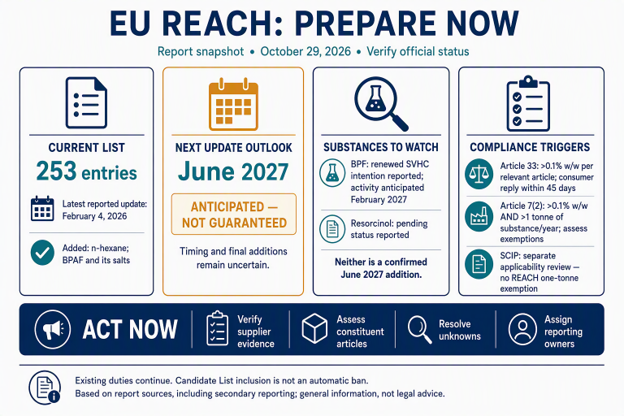
The next EU REACH Candidate List update is anticipated in June 2027, according to recent industry reporting. That gives companies time to prepare—not permission to pause compliance.
June 2027 is a planning assumption, not a confirmed deadline or a guarantee against an earlier update. The timing and final additions remain uncertain; existing obligations continue.
Continuing Obligations
The latest update took place on February 4, 2026, bringing the Candidate List to 253 entries. The additions were n-hexane and bisphenol AF (BPAF) and its salts. Keep in mind that entries are not necessarily individual chemicals and group entries can cover multiple substances.
Added February 4, 2026
The following SVHCs were added in early 2026:
· n-Hexane: EC 203-777-6; CAS 110-54-3. Listed for specific target organ toxicity after repeated exposure under REACH Article 57(f), reflecting an equivalent level of concern for human health.Reported uses include formulation, polymer processing, coatings and cleaning agents.
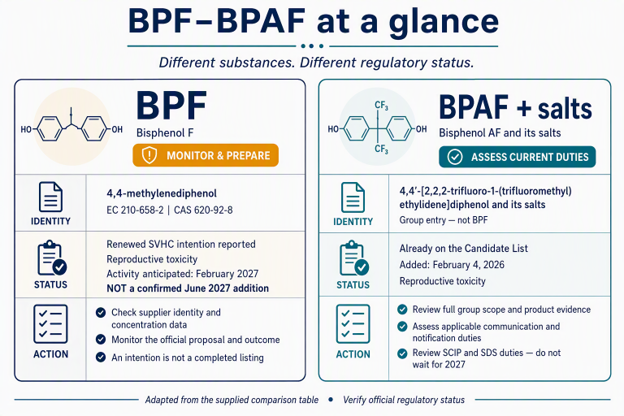
· BPAF and its salts: Listed for reproductive toxicity under Article 57(c). Reported uses include process regulation and cross-linking. Supplier reviews should address the scope of the group entry, not just one familiar substance name.
These substances are already listed—not prospective June 2027 additions. Companies should review their relevance now. The use of a chemical during manufacturing does not, by itself, establish its concentration in a finished article. Your company needs to have product-specific evidence.
Remember that a Candidate List inclusion is not an automatic ban. It can trigger information and notification obligations. The Candidate List may precede a separate decision to add a substance to the REACH Authorisation List. Companies should not confuse Candidate List identification with an authorisation requirement or a restriction. Candidate List implications.
A Watch List, Not a Forecast
No confirmed June 2027 package was established by the sources reviewed. Two substances merit attention, but their procedural positions are different. Neither should be described as certain to join the list in June.
Bisphenol F: The Clearest Signal
4,4′-Methylenediphenol (bisphenol F, or BPF), EC210-658-2 and CAS 620-92-8, has reappeared in reporting on the SVHC intentions register, with reproductive toxicity under Article 57(c) as the proposed basis and activity anticipated in February 2027. That makes BPF a sensible substance to monitor ahead of the June update—not a confirmed addition. BPF intention and anticipated consultation.
For companies using BPF-related resins, coatings, adhesives or composites, the practical question is whether the specific substance is present in supplied materials or remains in finished articles. Ask suppliers for substance identity and concentration evidence rather than assuming that all bisphenols, all BPF isomers or all resins have the same regulatory status. BPF is distinct from BPAF, which is already listed.
An intention is advance notice of a planned dossier. ECHA explains that stakeholders can follow proposals through the identification process and provide relevant substance-identity or hazard information during consultation. A planned submission or consultation does not itself create Candidate List status. How the SVHC intentions process works.
Resorcinol: A Substance to Monitor
Resorcinol, EC 203-585-2 and CAS 108-46-3, is another watch list substance. France’s Annex XV proposal addressed endocrine-disrupting properties, and August 2026 industry reporting described resorcinol as pending rather than formally included. That supports continued monitoring, but it does not establish a June 2027 inclusion date.
The appropriate response is to identify any relevant uses and keep the evidence current—not to label resorcinol a confirmed new SVHC.Before publication or a compliance decision, verify its live status and any subsequent decision in the official records.
Keep the categories separate: already listed substances require current compliance assessment; substances in the identification pipeline warrant preparedness; broader chemical concerns do not automatically belong in the June 2027 package. New proposals or procedural developments could change this watch list.
What to Do Next
Use the preparation window to build an evidence-based response, not simply to collect another “REACH compliant” certificate. The following checklist combines current regulatory triggers with recommended operational steps.
1. Recheck the current list. Screen raw materials, mixtures, components and imported articles against the official Candidate List. Prioritize closing any gaps relating to n-hexane and the BPAF group; do not postpone those reviews until 2027.
2. Refresh supplier evidence. Request dated declarations identifying the list version, covered part numbers, substance identities, and concentrations. Seek fuller material information where feasible and document unanswered questions. Treat “unknown” separately from “not present.”
3. Assess the correct article level. For complex products, evaluate constituent articles that retain their article status rather than diluting a substance concentration across the mass of the whole assembly. The 0.1% weight-by-weight threshold applies at the relevant article level. ECHA guidance on constituent articles.
4. Audit Article 33 communications. Where an article contains a listed SVHC above 0.1% weight by weight, provide business recipients sufficient information for safe use, including at least the substance name. Establish a process to answer applicable consumer requests within 45 days.
5. Check Article 7(2) separately. Assess notification where a listed substance exceeds 0.1% weight by weight in articles and its total quantity exceeds one tonne per producer or importer per year, taking account of exemptions. The notification timetable is six months from inclusion; it is not a blanket grace period for other duties.
6. Review SCIP readiness. Determine which EU entities and articles are subject to SCIP duties under the Waste Framework Directive. Validate article identifiers, substance information, and safe-use information. Do not apply the REACH one-tonne notification threshold as a SCIP exemption.
7. Review safety data sheets and supporting records. Check whether applicable SDS obligations require changes for substances or mixtures. Align supplier declarations, purchasing specifications, and customer information; do not assume every SDS automatically needs revision solely because of a listing.
8. Create a distinct emerging-substance watch list. Flag BPF and resorcinol separately from the confirmed Candidate List entries. Assign responsibility for monitoring official intentions, consultations and decisions, recording the status, and source date of each change.
9. Investigate alternatives before a deadline forces the issue. For relevant substances, compare alternatives for hazard profile, performance, availability, and qualification needs. Avoid replacing one problematic substance with a close substitute without assessing its hazards and regulatory trajectory.
10. Rehearse the update response. Assign owners across procurement, product stewardship, engineering, quality, and legal. Test how a newly listed substance would trigger screening, supplier follow-up, customer communication, and any required submissions. Set internal completion dates before the anticipated June 2027 update, while maintaining ongoing monitoring.
Collecting supplier declarations can be challenging when you manage a large supply chain and a high product or part count. We can help you assess your collection process and identify where a supplier checklist, a questionnaire, or automation support may be helpful. Contact us to discuss your needs and explore an approach that fits your team and supply chain.
The Bottom Line
Use the preparation window to strengthen product data and supplier evidence. June 2027 remains the anticipated—not guaranteed—next update, and its contents are unsettled. Existing duties continue: distinguish listed substances from emerging proposals and be ready to act when the official list changes.
Turn EU REACH complexity into clear next steps with our practical classes and tailored consultation services—contact us to build your team’s knowledge and tackle your compliance questions with confidence.
Get a BlueCircle Advisors Quote Today
Links
ECHA Registry of SVHC intentions until outcome

Compliance and ESG Newspaper
Stay Informed About Product Compliance